A new way to build software
From a Slack message to production. Agents handle triage, specs, estimates and retrospectives, and people review and decide. No sprints, no story points, no standups.
Most of the week isn't code.
Specs, status updates, estimates and meetings fill the rest. That is the work Glideship hands to agents, so people keep the decisions and get the time back.
is how much of their time developers spend coding, Atlassian reports. The rest of the week goes on everything around the code.
Industry research from the sources linked above. These are not Glideship results.
From idea to close, in two minutes.
Follow one feature through the phases below, from the first draft to the closing retrospective.
Read the transcript
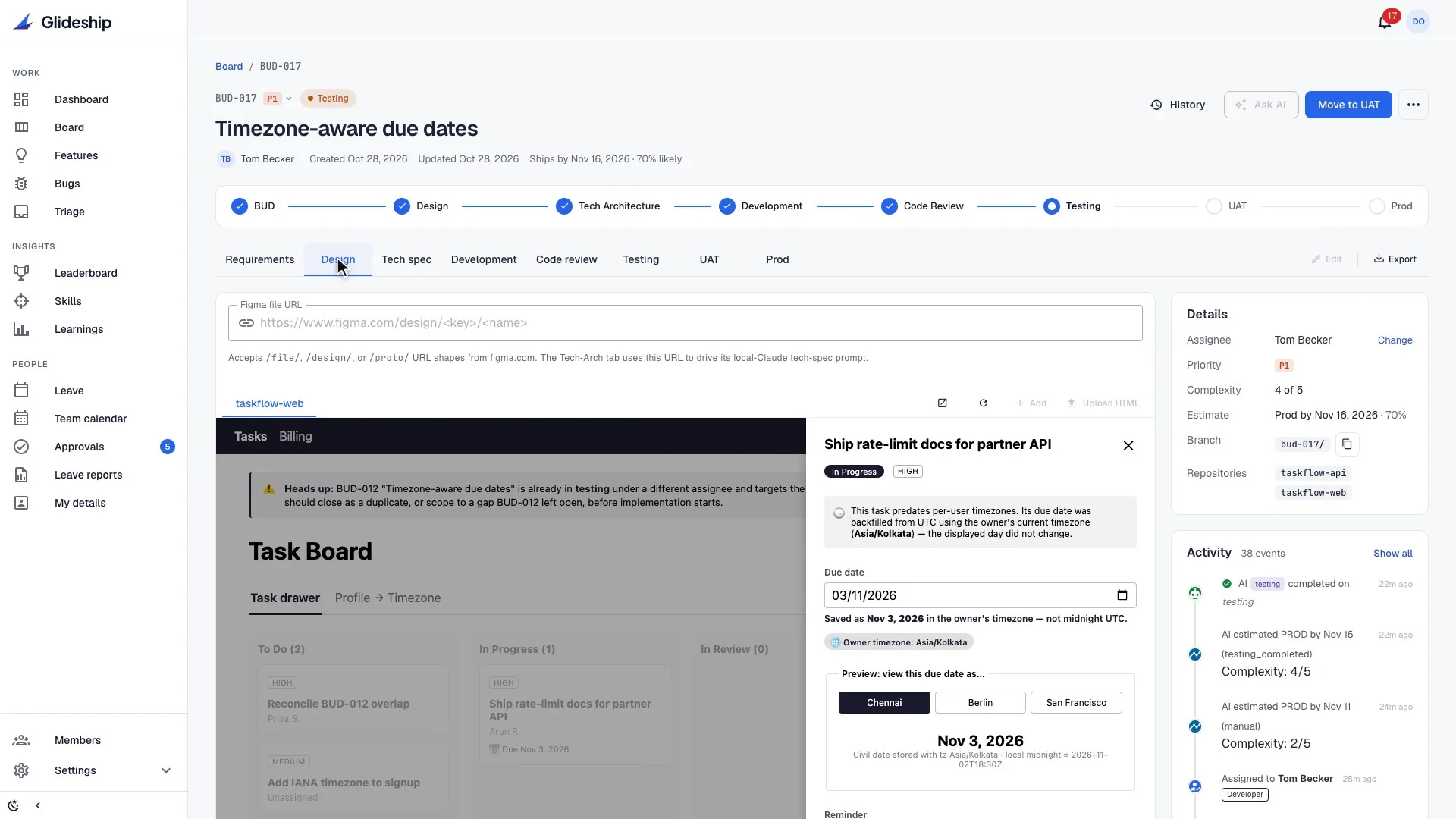
In Glideship, every feature lives in one document called a BUD, a Business Understanding Document. This board has a column for each stage, from the first request to closed. Each card shows the BUD number, priority, complexity, the assignee and any open bugs. You can filter by title, assignee, priority or team.
Daniel creates a new BUD with a title, a short description and a priority. Under advanced settings he chooses which phases the agents should draft for him. Here he turns them off, so the team writes this one by hand. Here is one further along. The header shows the stage, the assignee, and the date it is likely to ship.
The tabs follow the lifecycle. Requirements, design wireframes, the tech spec, implementation to-dos with their pull requests, code review, and the test plan. It is all one document. Each section keeps its history, so you can compare versions and restore an earlier one.
Below the tabs is the go-live forecast. Instead of story points, it gives a range of dates, from an optimistic one to one that is safe to promise. Moving forward is one button. Design, then tech architecture, development, code review, testing, UAT and prod. The page opens the tab that matches the new stage.
Once the work is live in production, the BUD is closed. The people who shipped it get the credit, and the BUD can feed a short retrospective. One document, from the first request to the last lesson.
Nine phases. One BUD.
Every feature follows the same path. At each step an agent drafts the work and a person reviews it, changes it and moves it on.
A request comes in
Someone asks for something in Slack. The Triage Agent reads it, checks for duplicates and runs a short interview about business impact, who it is for, timing and dependencies.
Reads the request, looks for duplicates, sizes the work from the code, and suggests a priority to the product manager.
Shares the idea and answers the questions. A product manager or the org owner reviews the triage, adjusts it and moves it on to a BUD.
Agents do the process work. People decide.
An agent never ships on its own say-so. Each draft lands in front of a person, who can approve it, change it or send it back.
Agents handle
- Sorting new requests and spotting duplicates
- Drafting BUDs from your real code
- Scoping design work and writing the tech plan
- Writing test cases, automated and manual
- Linking bugs to BUDs and watching bug counts
- Tracking status and keeping stakeholders posted
- Spotting patterns and writing retrospectives
- Mapping skills and suggesting who takes what
- Keeping knowledge in sync with the code
- Delivery dates with real odds (AI-PERT + Monte Carlo)
People handle
- Reviewing and approving every phase
- Code review and architecture choices
- Visual design, in the tools they like
- Business trade-offs and priorities
- Quality checks and UAT sign-off
- Reviewing or overriding reassignments
- Curating knowledge and team rules
of developers distrust the accuracy of AI tools, more than the 33% who trust it. Only 3% highly trust the output.
SourceStack Overflow Developer Survey 2025· 33,244 responses
Eight trades we made.
- 01AI first draftsoverstaring at a blank page
- 02Delivery forecastsoverstory points and planning poker
- 03Learning as you gooverpost-mortems after the damage
- 04Human decisionsoverhuman busywork
- 05Living knowledgeoverstale wiki pages
- 06One BUD per featureoverscattered tickets and docs
- 07Skills that grow with the teamoverfixed role assignments
- 08Quality loops that run themselvesovermanual bug triage
Questions, answered.
What is Agent-Driven Development?
Agent-Driven Development (ADD) is a way of building software where specialised AI agents drive every phase of the lifecycle — intake, spec, design, tech architecture, implementation, testing, UAT, deployment, retrospective — and humans review, decide, and steer. Glideship is the open-source reference implementation.
Is Glideship a self-hosted Jira alternative?
Yes — for the workflow layer. Glideship sits between IDE-side AI coding assistants and traditional PM tools. It is especially relevant to teams looking for an Atlassian Data Center alternative, since Atlassian stopped selling Jira Data Center to new customers in March 2026 and Data Center reaches end of life in March 2029.
Does my code leave my machine when I use Glideship?
The data plane is always local — Postgres, embeddings, BUDs, scanned repos, and the audit log all sit on your hardware. Only the LLM prompts leave your machine, and only when you choose a cloud inference mode.
What does BUD mean in Glideship?
BUD stands for Business Understanding Document. Every feature lives in one BUD containing spec, tech spec, test plan, acceptance criteria, and full history — all in markdown.
What is Glideship's licence? Can I use it commercially?
Glideship is licensed under the Apache License 2.0, which permits commercial use including embedding in proprietary products. Contributions require DCO sign-off via git commit -s.
See it run on your codebase
One command. Needs Docker and Node.js 18 or later. Your code and data stay on your machine. npx glideship init